AEO Audit Tool: Review Content Readiness and Find Fixes
An AEO audit reviews whether a page explains its topic clearly, answers the questions readers bring to it, defines important entities and presents useful information in accessible structure. Amisora evaluates public web pages against its own content-readiness model and identifies editorial issues worth reviewing.
This page explains the checks, example findings and scoring limitations before you create an account. The Amisora audit is not a live test of whether ChatGPT, Perplexity, Gemini or Google AI Overviews currently cite your website.
A free Amisora account is required to run an audit. Free-tier page limits apply.
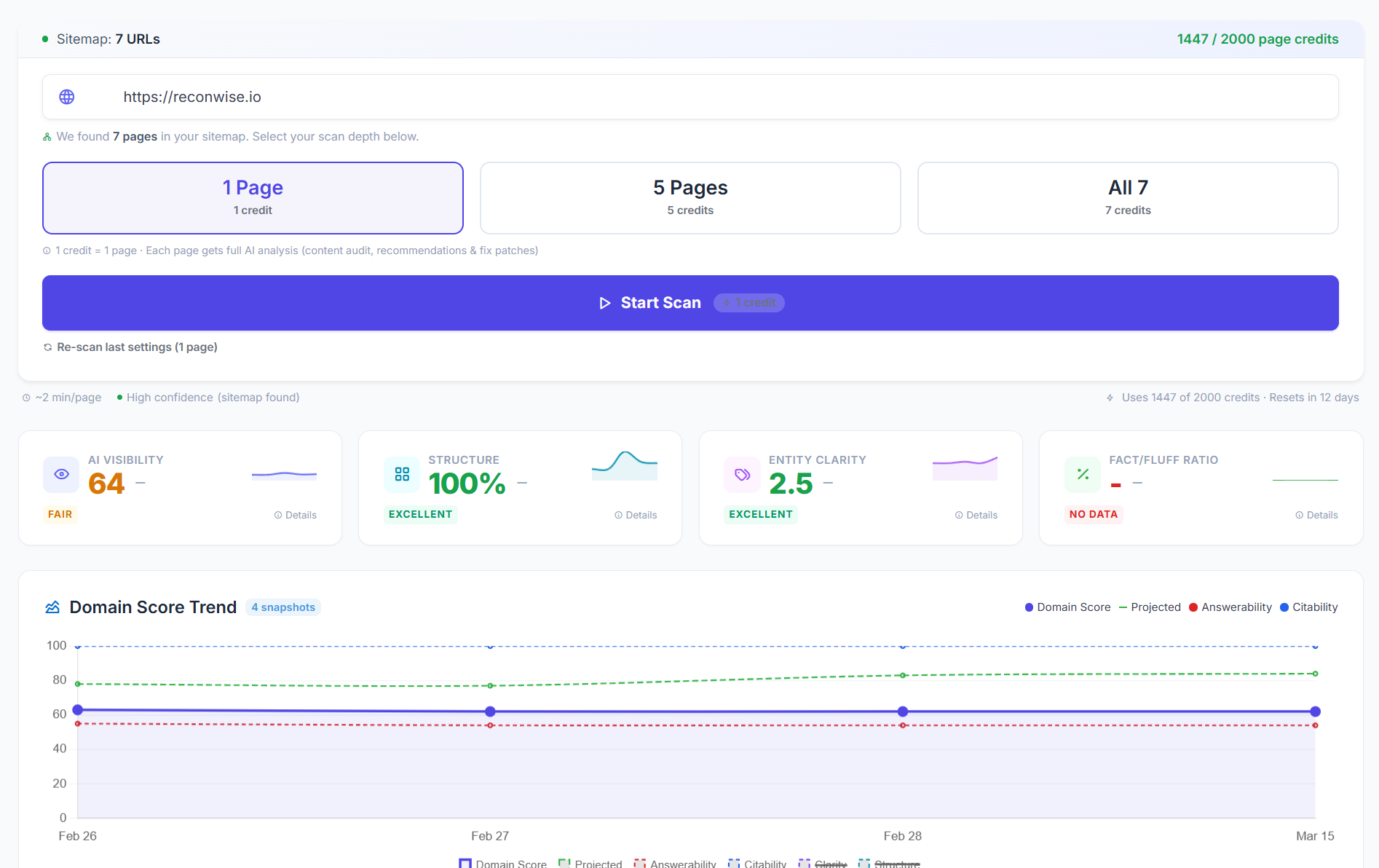
What does the Amisora AEO audit assess?
The audit looks for editorial and structural characteristics that a human reader can also recognize. Its purpose is to make pages easier to understand and improve, not to reverse-engineer private AI-ranking formulas.
Answerability
Does the page answer its core question directly? A headline such as “How does the integration work?” should be followed by a usable explanation, not just a promotional slogan. Strong passages identify the product or concept, explain the conditions and give the reader a next step.
Citation readiness
Are important claims specific, supported and attributable? Clear definitions, dated facts and links to primary sources help readers verify what a passage means. Amisora's citation-readiness score describes these content traits; it does not count citations earned in actual AI answers.
Ambiguity risk and entity clarity
Can a reader distinguish the company, product, feature and use case being discussed? Undefined acronyms, conflicting product names and unsupported comparisons create ambiguity. Entity clarity is considered within the published readiness methodology, rather than being a promise that an answer engine will recognize the brand.
Extractability
Can someone find and reuse the relevant information without deciphering a dense block of prose? Descriptive headings, meaningful lists, well-labeled tables and readable HTML can make complex material easier to navigate. Formatting is valuable when it genuinely clarifies the answer; adding markup alone does not guarantee a citation.
For the documented dimensions, diagnostic signals and score calculation, see the Scoring Methodology.
A worked example of an AEO audit finding
Illustrative editorial example — not a real Amisora scan
Imagine a fictional SaaS company, Pineboard, with a product page answering “Can I export project data?” The important user intent is whether export is possible, which formats are supported and where the action happens.
Before — unclear answer
Pineboard helps teams unlock powerful possibilities with flexible data experiences and seamless workflows.
Finding — what an editor should check
The copy does not answer the export question. It gives no format, location, restriction or relevant documentation link. A readiness audit can flag answerability and clarity concerns, but an editor must confirm the actual product behavior before making a factual claim.
After — a clearer hypothetical answer
Pineboard administrators can export a project's task list as a CSV file from Project Settings → Export. The export includes task titles, assignees and due dates. For other data types, consult the export documentation.
Pineboard and its described export feature are fictional. This example illustrates an editorial improvement, not a detected feature, actual Amisora result or measured citation increase.
What improved?
The revised answer identifies an actor, action, location, file format and scope. Those are verifiable details that help readers. It is not possible to infer from this example that AI platforms will cite the page.
See more content-structure examples in LLM-Extractable Content.
How the Amisora scoring model works
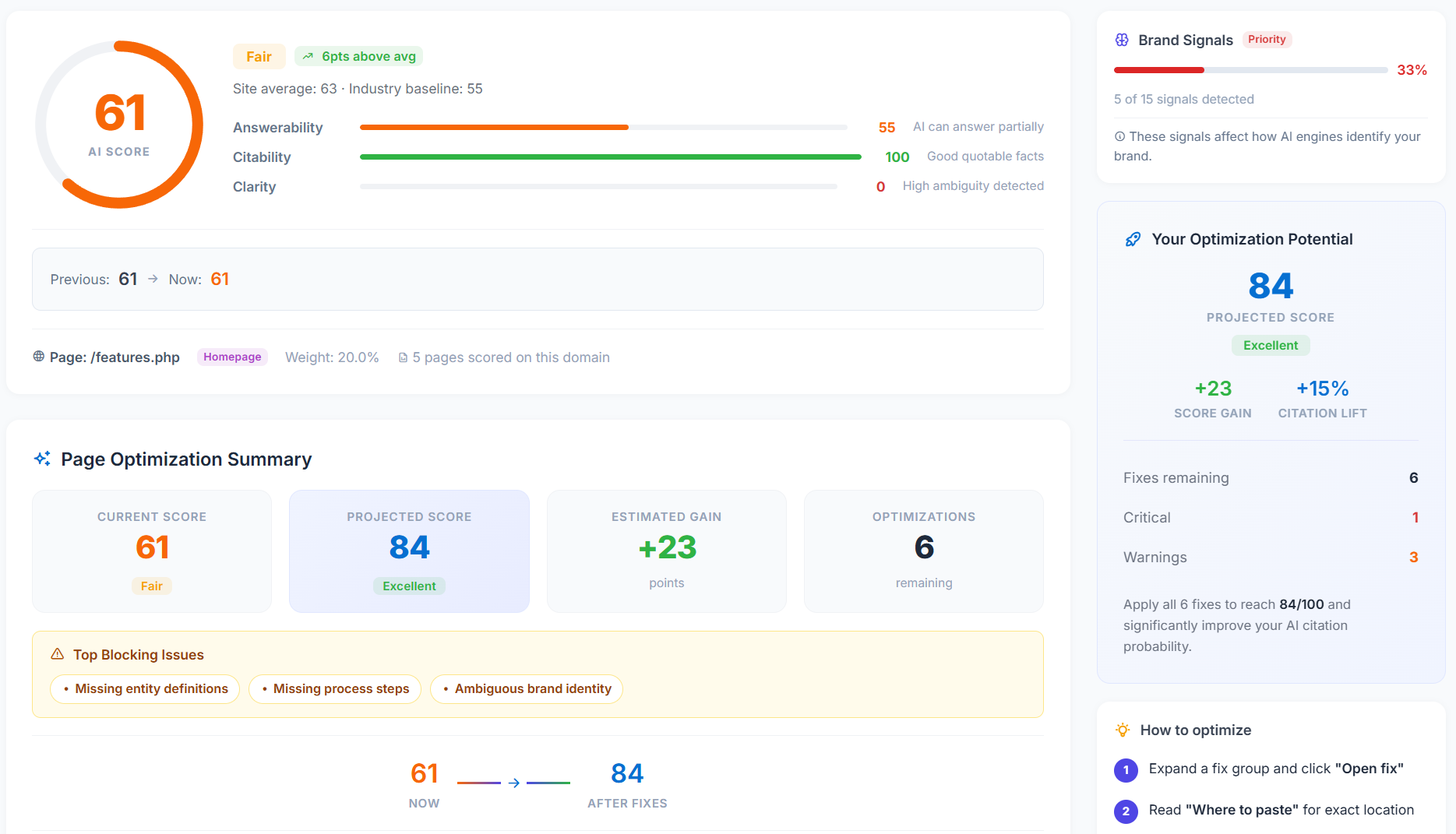
Amisora publishes a weighted internal readiness score composed of four assessment dimensions. The model is designed to help teams identify and prioritize editorial issues. It is not a score issued or endorsed by any search engine.
| Composite dimension | Published weight | What to review |
|---|---|---|
| Answerability | 35% | Clear, complete answers to important questions |
| Citation Readiness | 25% | Specific, attributable statements and useful supporting sources |
| Ambiguity Risk | 20% | Missing definitions, confusing references and entity ambiguity |
| Extractability | 20% | Heading structure and readable organization of information |
The audit also reports other diagnostics and derived metrics. They should not be mistaken for seven additional independent weights. Consult the methodology for definitions and the interpretation of each metric.
How to run an AEO audit with Amisora
Step 1 — Choose a useful public page or site
Start with a product page, service page, comparison or guide where clarity matters to users. The audit uses publicly accessible content; pages behind a login may not be suitable.
Step 2 — Start the available audit workflow
Select Start a Free AEO Audit and create or sign in to an Amisora account. The free tier has page-credit limits. The scan occurs through the Amisora product, not through this explainer page.
Step 3 — Review issues, not only the overall number
Look at the page-level findings and the passages they concern. A diagnostic score is most useful when it points an editor toward a concrete question: Is a definition missing? Is an answer buried? Does a claim need evidence?
Step 4 — Verify and publish safe improvements
Check recommendations against the real product, policy and source documents. Keep necessary nuance. Revisit pages after changes, but do not treat score movement as proof of higher Google rankings or additional AI citations.
AEO content audit versus SEO audit versus AI visibility tracking
| Assessment | Main question | Typical evidence | What it does not establish |
|---|---|---|---|
| Traditional SEO audit | Can search engines find, index and present the page effectively? | Crawling, indexing, links, page content, performance | Whether an AI answer mentioned the brand |
| Amisora content-readiness audit | Is the page clear, attributable and structured for readers and extraction? | On-page content, internal diagnostic scores, editorial findings | A live citation count or ranking prediction |
| AI visibility audit | Do selected AI answers mention the brand or cite its pages? | Recorded prompts, actual answers, visible source links, dates and platforms | A stable ranking across all AI users or prompts |
These assessments complement each other. A well-structured page still needs accessible content, an accurate offering and credible evidence. Visibility observations can change by prompt, platform, market and date.
For a repeatable way to record observed answers, read the AI Visibility Audit Guide.
What this tool can and cannot tell you
Can help assess:
- Whether a public page gives direct, usable answers.
- Whether readers can find key definitions, explanations and supporting references.
- Whether structure, headings and passages need editorial attention.
- Which findings may be worth fixing before publishing more content.
Cannot establish:
- That Google or any third-party AI engine uses Amisora's scoring weights.
- That your page has been cited, mentioned or recommended in a live AI answer.
- That a particular edit will produce a #1 ranking or citation.
- That a content-readiness audit replaces technical SEO, customer research or independent observation of AI answers.
Google says existing Search best practices remain relevant to AI Overviews and AI Mode, and no special AI-only optimization is required. See Google's official AI features guidance and Google's AI optimization guidance.
Frequently asked questions
Review a page before you rewrite it
A useful audit should give your team specific issues to investigate, not a vague instruction to add more keywords. Start with a public page, review its readiness findings and make only changes that are accurate for your business.
Free account required to run the audit. Scores describe Amisora's content-readiness model, not live AI citations or guaranteed search rankings.